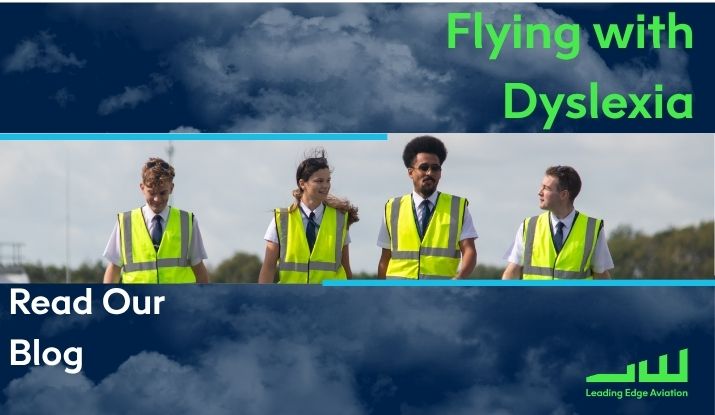
Are you worried about trying to become a pilot or join the aviation industry and concerned about how having dyslexia may affect your job performance or training? We sat down with one of our students during his journey to becoming a pilot with dyslexia and how it has affected him throughout his time at Leading Edge Aviation.
The CAA and EASA don’t discriminate against a person with dyslexia but, unlike school, they do not give any additional time or help during exams. So, like our interviewed student has said, knowing a subject in depth helps overcome the additional difficulties that a person might encounter during the qualifying exams. It is a level playing field for all students and we personally know many students and current pilots who are dyslexic who have used the same learning techniques as our interviewed student, and they have all had, or are having, a successful career in aviation.
Does your dyslexia affect your daily life in training?
Yes, mainly in the amount of time it can take me to fully process a large amount of information.
I first really noticed it during ground school, particularly with subjects like Meteorology, where there was a huge amount of information being delivered quite quickly. I could understand it, but sometimes I couldn’t absorb everything at the same pace as it was being taught.
That usually meant going back over things in the evening and spending longer studying so I could properly digest what I had learnt.
At the same time, I’ve found there can be a positive side to that. Because I often have to spend longer getting my head around something, I tend to want to understand how all the different pieces connect rather than just memorising individual facts. Once something properly clicks, that deeper understanding can become a real strength later on.
What part of training would you say you found the hardest and why?
Funny enough, one of the subjects I found hardest was Air Law.
A lot of it involved working through large amounts of content independently, and that was difficult for me because reading through page after page of information isn’t necessarily how I learn best.
When something is being explained, discussed or demonstrated, I can ask questions and build a picture of how it works. When you’re faced with a large amount of written material on your own, it can take me considerably longer to work through it and make sense of everything.
That experience did teach me quite a lot about how I learn, though. I became much better at recognising when a particular way of studying wasn’t working and finding another way around the problem.
Did you have to develop any specific processes to help you?
Definitely. The biggest thing for me was making sure I actually understood what I was learning rather than simply trying to memorise it.
I ask a lot of questions. If something doesn’t quite make sense, I’ll keep asking questions until I can connect all the pieces together in my head.
I also break large amounts of information down into much smaller sections. Bullet points, diagrams and clear processes are much easier for me to work with than a large block of text.
Over time, you also become quite good at problem-solving your own learning. If one way of explaining something doesn’t work, I’ll try another way until it does.
The disadvantage is that it can take me longer initially. The advantage for me personally is that by the time I’ve finished working through something, I’ve normally developed a very solid understanding of it.
What type of learning style suits you best?
Visual and practical learning, without a doubt.
Diagrams are probably one of the biggest things that help me. Lots and lots of diagrams!
I also need to understand why something is happening rather than simply being told that it happens.
A good example from ground school was learning about gas turbine engines. Rather than just remembering the individual components, I found myself visualising the engine almost three-dimensionally in my head and imagining what was happening to the airflow as it travelled through it.
That kind of visual-spatial thinking has been really useful throughout training. If I can create a picture of something in my head and understand how all the pieces interact, I find it much easier to remember and apply later.
Did you have any support or help within or outside your training?
One of the biggest forms of support for me has simply been being able to ask questions.
I’ve never been afraid to ask somebody to explain something again or explain it in a different way. Asking questions helps reinforce my understanding and lets me check that the picture I’ve built in my head is correct.
I also made the decision quite early on that I wasn’t going to allow dyslexia to become an excuse. I knew some parts of training might take me longer, but my attitude was that I was going to find a way through it one way or another.
That ability to find another approach when something isn’t working is probably something dyslexia has actually helped me develop over the years.
Did you have concerns or fears about training before you started?
Absolutely.
Before starting, I’d have people tell me that becoming a pilot would be too difficult because I was dyslexic. When you already know that studying can take you longer than other people, hearing things like that can put additional pressure on you.
There was definitely a part of me that wondered whether they might be right.
I feel different now as I’ve managed to get through a huge amount of demanding training and academic study, so when I look back at those comments, I’m proud of how far I’ve come.
If anything, being doubted gave me additional motivation. It gave me something to prove, both to other people and to myself.
I also think having to overcome those difficulties builds resilience. When you’ve spent years knowing that you might have to work harder or approach something differently, you become very used to not giving up just because something doesn’t click immediately.
Does dyslexia affect how much information you can take in, and did this affect your exams?
It can affect how quickly I take information in, especially when a lot of information is being presented at once.
During ground school, that sometimes meant that the lesson itself wasn’t enough. I would go home and spend extra time going back through what we’d covered until everything made sense.
Exam questions could sometimes be difficult for a slightly different reason. Occasionally I knew the subject well, but I’d have to read the question several times to work out exactly what it was asking.
That becomes particularly difficult when a question is deliberately worded in a way designed to test whether you’ve noticed a small detail.
For me, the solution was lots of practice questions combined with understanding the subject behind them. Rather than relying purely on memory, I wanted enough understanding that I could reason my way towards an answer.
When it comes to reading technical material, do you feel that you can occasionally struggle?
Yes.
A large block of technical writing can be difficult for me to process. It’s not necessarily that I don’t understand the subject; getting the information from the page into my head is sometimes the difficult bit.
I naturally want to break information into smaller pieces, bullet points, diagrams or processes.
That’s actually one reason aviation checklists work extremely well for me. I sometimes joke that a checklist is a dyslexic person’s best friend.
The information has already been broken down into individual steps and placed into a logical order. Half of the work I would normally have to do myself has already been done.
I think that also fits quite naturally with aviation because so much of flying is based around organised procedures, flows and breaking complex tasks down into manageable steps.
When studying for exams, what was your ideal working environment?
My study method was very question-based.
I’d answer lots of questions, identify what I didn’t understand and then go back and work out why the answer was what it was.
I didn’t just want to memorise the correct option from a question bank. I wanted to understand the subject well enough that it almost melted into my brain and became something I could reason through.
Diagrams were also a massive part of that. If I could turn something into a picture or visualise what was happening, I found it much easier to understand.
Once I reached that point, I didn’t have to rely as heavily on remembering individual facts because I could often work my way towards the answer using my understanding of the subject.
Do you ever have to make sure the people around you are aware that you are dyslexic throughout your training?
I don’t usually tell people I’m dyslexic. I’ve never really felt embarrassed asking an instructor to repeat something or explain something differently.
My attitude is that I’ve invested an enormous amount into being here and into becoming a pilot, so I’m going to make sure I get everything I possibly can out of the training!
If I don’t understand something, I’ll ask. I’d much rather ask another question than walk away pretending I’ve understood something when I haven’t.
Has dyslexia affected you differently during practical flight training compared with ground school?
Interestingly, this is where I feel some of the difficulties I had during ground school actually started to become strengths.
Because it can take me longer to initially process information, I tend not to just memorise things. I want to understand exactly what is happening and why.
Once I started flying, that deeper understanding became really useful. For example, with instruments and navigation aids such as a VOR, I didn’t just want to know what indication I should be looking for. I wanted to understand what was happening behind that indication and why the instrument was showing me what it was showing.
Once I’ve understood something properly like that, I find it tends to stay with me. I don’t feel like I’m constantly having to relearn the same information.
I also think the visual side of the way I learn helps. Being able to create a mental picture of where I am, what the aircraft is doing and how different pieces of information fit together can be very useful when you’re flying.
I wouldn’t say dyslexia automatically makes somebody better at practical flying because everyone is different, but for me the way I’ve learnt to process and understand information has definitely helped once I’ve had to apply the theory in the aircraft.
What would you say to another dyslexic person who wants to become a pilot but is worried they aren’t academic enough?
Set your own goals and don’t measure your ability by how quickly somebody else learns something.
One thing I’ve realised through training is that everybody has different strengths. Someone might find ground school relatively easy but then have to work much harder during the flying. Someone else might find the theory difficult but really come into their own once they’re in the aircraft.
Being dyslexic means I’ve been used to having to work harder academically for a long time. At times that can feel like a disadvantage, but it also teaches you how to work when something doesn’t come easily.
You become used to finding another way of understanding something rather than giving up when the first approach doesn’t work.
It also means you become very aware of how you learn. You quickly work out whether you need diagrams, questions, practical examples, repetition or something explained in a completely different way.
Before starting training, I’d had people tell me that I wouldn’t be able to do it because I was dyslexic. My response usually goes along the line of “just see how far I’ve come.”
If becoming a pilot is what you genuinely want to do, don’t let the fact that you might have to work harder convince you that you aren’t capable of doing it.
Do you think dyslexia has given you any strengths during training?
Yes, definitely.
For me, the biggest strength is probably how deeply I try to understand something. Because taking information in initially can sometimes be harder, simply memorising facts has never been the best option for me. Instead, I’ve developed a habit of asking why something happens, visualising it and trying to understand how all the pieces fit together. That has helped enormously when it comes to applying theoretical knowledge during flying.
I also think visual-spatial thinking has been a strength. Being able to picture systems, situations or movements in my head can make complicated ideas much easier for me to understand.
Another strength is problem-solving. Dyslexia means I’ve spent a lot of time throughout my life finding different routes to the same answer. If one method doesn’t work, you try another one. That’s quite a useful mentality to have during flight training.
I also find that once I’ve built a strong understanding of what “normal” looks like, I naturally start looking for patterns and noticing when something doesn’t quite fit. In aviation, developing that awareness and looking at the bigger picture is extremely important.
The other major strength is resilience and work ethic. If you’ve reached flight school as somebody with dyslexia, you’ve probably already spent years learning that sometimes you’re going to have to put more work in to get the result you want. You learn to keep going when something doesn’t click immediately. You learn not to drop the ball because you’re used to having to stay on top of things.
Most importantly, dyslexia has forced me to understand how I learn. I know that I need to ask questions, see things visually, understand the reason behind something and then apply it practically.
Dyslexia has definitely made parts of pilot training harder for me, but it has also helped develop the way I problem-solve, visualise information, work through setbacks and build a deeper understanding of what I’m learning.
Those are strengths I believe will continue to help me throughout the rest of my training and hopefully throughout my career.
If you’re thinking about a career as a pilot, we hope this helped you get an insight into the life of a trainee pilot with dyslexia. As we spoke with the student, we got an understanding of the struggles he faced, such as finding difficulty in taking in the extent of information from ground school lessons, but also making ways to overcome these issues by never being afraid to ask a question and do extra study to make sure they fully understood the lesson so they didn’t fall behind or get lost in their studies.
If you’re looking to start your journey to the flight deck, check out our courses here: