Scared about starting ATPL Ground School and have questions about how to succeed?
This week, we sat down with our Graduate and recipient of this years “Best in Ground School” award, Taylor Bayley, who achieved an incredible 99% average in both UK and EASA Ground School to get his top tips on the all-important ATPL Ground School.
Difficulty Level
How would you describe the difficulty level of the Ground School content?
I think the difficulty of the ground school content was more in the quantity and pace of the content rather than there being lots of concepts that are hard to grasp. There were definitely times where I’d finish a day with so many facts and figures to remember I wondered where I’d begin! But the advantage of this is that remembering figures is just a game of time and repetition – and in the subjects that do have some difficult concepts, the TKIs (Theoretical Knowledge Instructors) always succeeded in finding a way to present it in a way I understood.
Which of the 13 subjects did you find the hardest/easiest and why?
I suspect a lot of people will think this is a hot take, but I found Air Law & Operational Procedures the hardest and General Navigation & Flight Planning the easiest. The former two had so many numbers and facts to memorise where it became quite easy to get them jumbled up, whereas the latter contained theory and formulae that – whilst trickier to understand at first – meant when you had mastered them, you could answer most of that topic’s questions on an exam without having to rely so heavily on the bank.
Bank Questions, Flashcards, what actually works?
What were your most used study resources (i.e. pad pilot, ATPL Bank)?
Initially with any subject, I primarily used the presentations from the instructors which I annotated during the lessons. After that, my primary source to ‘get to grips’ with the knowledge were flashcards – I used the same app as I and many others use at university called Anki that uses spaced repetition to help you learn them: when you get them right, they are shown to you less frequently e.g. once a week, compared to those that you get wrong where you’ll see them every day until you get them right! Finally, the ATPL bank is an absolutely vital resource – especially for those subjects like Air Law that are a long string of facts – that I’d usually try to go through twice for each subject as well as reattempting multiple times the ones I had got wrong.
Did you have a study process for approaching exams, if so, what was it?
Ditto the above really, same sequence of presentation -> Flashcards -> Bank!
When and Where?
What did a typical day of studying look like for you alongside lessons?
I usually came in a little early to class to complete some flashcards and bank questions, did the lessons, and then at the end of the day created flashcards from that day’s learning before doing the VLE topic quizzes. Then, I’d practice a few questions on the bank to see what the exam focussed on (and add any flashcards I’d missed from that), before heading off.
Did you prefer to study at home, in the academy or out and about?
I am a fairly strong believer in keeping firm boundaries between work and relaxation/sleep, so I primarily studied in the Academy and out with friends – other than doing a little bit of bank to pass the time, I refrained from studying in my bedroom so that was always a place I went after my work was done for the day and I could unwind and sleep.
Advice on how to do your best
What do you wish you’d known before starting ground school?
I wish I’d known that feeling somewhat overwhelmed in the first part of each module is entirely standard. Particularly in aviation, a lot of people project a calm confidence, but ground school can be like learning from a fire-hydrant at times and everyone feels the weight of the volume of information. But working together with your classmates in combination with using your revision material & the bank, I guarantee that the concepts will click into place in time for your exam.
What is the biggest mistake students make in their first few weeks?
The biggest mistake I think is misjudging the workload – not only can you not work hard enough, you can also definitely work too hard. The information you get taught in the first day of each topic is just as important as the information on the last day as it will all be in the exams, so you need to make sure you keep up with the information as it is presented to you rather than trying to catch up on it all at the end. For me, that took the form of flashcards and bank to keep up, but find what works for you.
This all said, I think it’s equally if not more important to make sure you don’t work too hard – I remember before and during ground school so many people appearing on TikTok and reels implying there was some imperative for me to work for hours and hours every evening and weekends, but quality rather than quantity of work will achieve the same results while retaining work-life balance.
For me, my latest work cutoff during the week was about 7.30pm, and during the weekend except in the run up to exams I would always have one of the days completely off to recharge, because ground school is a marathon not a sprint. You really don’t need to work every hour of the day to do well – I certainly didn’t – you just need to know how you learn most effectively and do that consistently. You don’t have to say goodbye to your friends and hobbies for 28 weeks!
What advice would you give to someone feeling overwhelmed by the volume of information?
Try not to panic and definitely don’t let yourself get burnt out – take some time for yourself to have a breather and do something that you enjoy before getting to work as no one works well when overly stressed (you’ll find out more about this in HPL!). When you do start working, make sure you’re doing something that is effective for you – staring at your notes probably won’t help much. Don’t forget you have all the amazing TKIs to help you and you also have your classmates who are in it with you and may provide you with another perspective on the same concept. Lastly, remember where you’re going – ground school felt like a bit of a marathon at first but in the end it flew by and it feels like I’ve blinked and now I’m learning to fly an A320 at BA!
If you could give only one tip for getting through ground school, what would it be?
Before you start, it’s really important that you know how you learn best – for me, that is annotated presentations, flashcards, and past questions from the bank; but that definitely varies person to person – I have many friends from university who absolutely had to write things down with a pen and paper and would run a mile from my strategy of doing all my notes and flashcards electronically! If you don’t know, that’s when you become someone saying the only way to pass ground school is to work every hour of the day, but once you’ve mastered your most effective way to retain information, it makes it easy to hit the ground running in ground school, because there isn’t a long warm up period and everything you’re taught from day 1 is important.
We hope Taylor’s answers to our questions has made the journey through Ground School clearer and more managable.
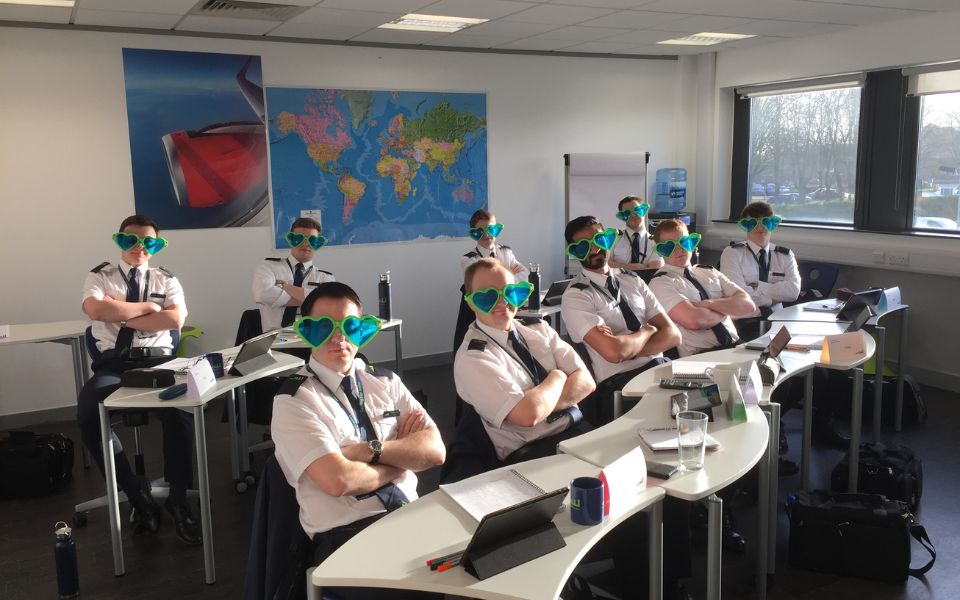
Every Pilots’ journey starts in the classroom, not in the cockpit. Our ATPL Ground School results are some of the best in the UK and we owe that to our fantastic team of Theoretical Knowledge Instructors and Support Staff who make it all possible!
If you want to start your journey, get in touch with one of our training advisors below!